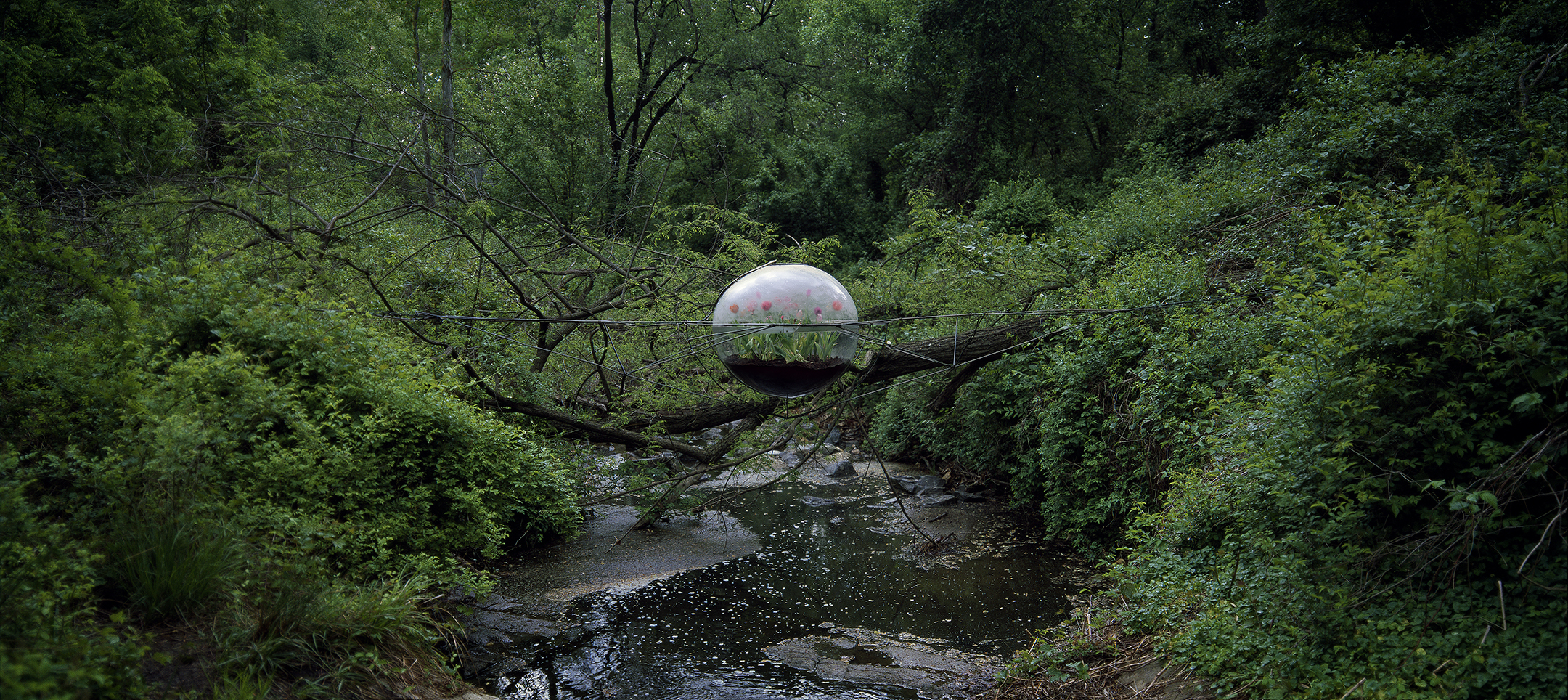
“The question of being is an entity’s mode of being . . . and its character derived from its inquiries.” — Martin Heidegger, Being and Time, 1927
Jeremy Thomas Kunkel creates work that serves as a bridge between the viewer and their present reality, an inquiry into the relationship between self, shared space and the act of being. For him, to be an artist is to work at the threshold between consciousness and the natural order, and to act in service to the space that surrounds us, not to dominate it, but to create with intention, equity and an honest acknowledgment of our interconnected existence.
The threshold Kunkel describes is less a place than a moment. It is the act of solving as it happens, in situ, before any answer has settled, between what has been and what is about to be. It appears wherever two things meet and must answer to each other: two materials, a conflict and the condition that holds it, two people in conversation, the natural world and the conscious human mind. It belongs to neither side. It is the live exchange between them, never the solution, only the solving.
In his practice the threshold appears first in the making. An idea, a condition or a conflict compels the work, and the material answers back with its own history, weight and behavior. Craft and concept meet there, and neither leads for long. Kunkel thinks of creativity as that exchange, and of the finished piece as a record of the negotiation rather than its end. The threshold then moves outward to the viewer. He does not hand over a narrative. He places materials and arrangements in view, carrying meanings from a world the viewer and artist share, and leaves the solving to them. A bronze brick set into a family’s home joins past to present each time someone walks past it. An urban island exists only because the built and natural worlds are still contesting the same ground.
We live in a world saturated with distractions and constructs designed to dictate our actions and obscure our truths. Art, in Kunkel’s view, exists to cut through that fog. His work seeks out the raw spaces where the urban and the organic collide, where discarded materials hold the memory of their origins, and where human hierarchies falter against the enduring reality of nature. The Urban Island is his conceptual framework, a microcosmic landscape of isolation and intersection where nature persists within the remnants of human action. At times these conditions force us to see the displacement of others, communities marginalized and individuals abandoned, and to recognize in them a beauty we too often mistake for a mirror of our own fear.
For Kunkel, art is a craft, and craft is communication. To craft is to respect both the qualities of a material and the outcomes it can generate, shaping meaning rather than imposing it. He rejects art that prescribes a single way of thinking. His work is an open inquiry, a space for reflection rather than resolution, asking how we might reconcile our internal truths with the realities we share.
Everything we do is temporary, while everything we have done is permanent.